Ethnic Groups, Demographics, and Cultural Heritage of Nepal
The Magars inhabit the western and central hills of Nepal. Before the 18th century, they maintained their own kingdoms and were closely linked with the Hindu Indo-Aryans in the western regions. Many of their cultural practices have been influenced by the Chhetris, making it challenging today to distinguish between the two groups in terms of housing, clothing, and farming. The Magars have long been recruited by the British and Indian armies, with many serving in Gurkha regiments. A similar ethnic group, the Gurungs, lives slightly further east in the western and central hills. Of Tibeto-Burman origin, the Gurungs have their own language and practice shamanism. Many also serve in British and Indian military forces.
The Khas group, which includes the Bahuns and Chhetris, historically established kingdoms in the far western regions. Bahuns traditionally serve as priests and are among the most educated ethnic groups, often holding key government and educational positions today. Chhetris are known as warriors, and those residing in the higher hills face challenging lives due to limited rainfall, cultivating land mainly in river valleys and hill slopes.
The Tharus are among the original inhabitants of the Terai plains, while other ethnic groups such as the Majhi, Danuwar, Rajbansi, Darai, Satar, and Dhimal also occupy the flatlands. Tharus follow their own indigenous religion and practice animism. Their culture is well-suited to the hot plains, and they have natural resistance to malaria. They have Mongoloid features and speak their own language.
Cultural boundaries are increasingly fluid due to migration, and the urban population grows by about 7% each year, resulting in significant intermingling among communities.
Demographic and Vital Statistics
- Population Density: 131.7 persons per sq km (341 per sq mi) (1991)
- Urban vs Rural: 9.6% urban, 90.4% rural (1990)
- Sex Distribution: 51.7% male, 48.3% female (1990)
- Life Expectancy at Birth: Male 55.4 years, Female 52.6 years (1990); Male 46 years, Female 42 years
- Age Distribution: 0–14 years: 41% | 15–64 years: 55% | 65+ years: 4% (1999 est.)
- Birth Rate: 38 per 1,000 (1993)
- Death Rate: 13 per 1,000 (1993)
- Population Growth Rate: 2.51% (1999 est.)
- Infant Mortality Rate: 90 per 1,000 live births (1999 est.)
- Total Fertility Rate: 4.78 children per woman (1999 est.)
Location and Geography
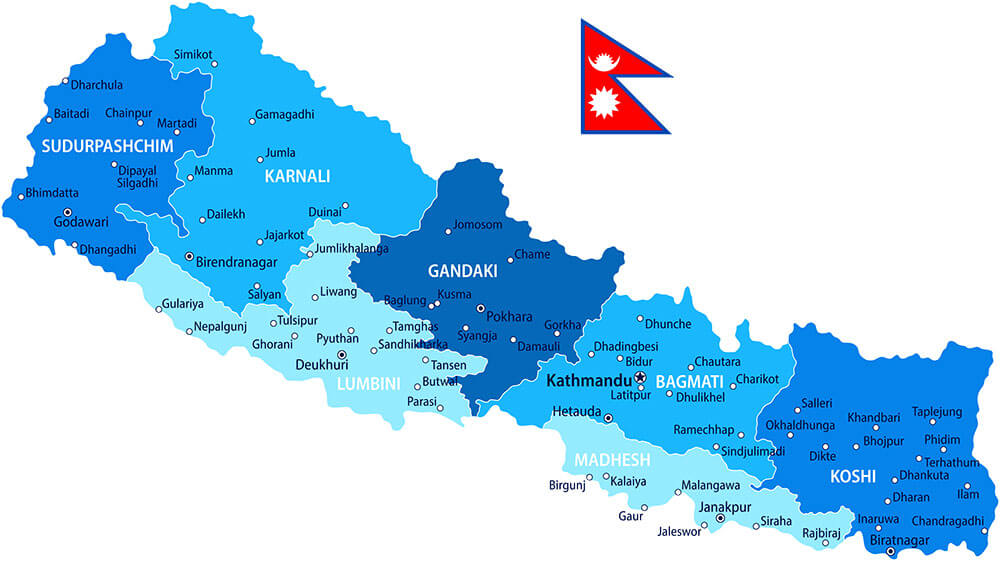
Nepal is situated along the southern slopes of the Himalayan Mountains in South Central Asia, bordered by China to the north and India to the east, west, and south. The country is divided into three main topographical regions:
- High Mountains: Including the Himalayan peaks such as Mt. Everest, Mt. Lhotse, and Mt. Makalu.
- Kathmandu Valley: A circular basin enclosed by tertiary ranges known as the Siwalik Hills.
- Terai: A narrow, fertile flat belt along the southern border with India.
Major rivers include the Kosi, Narayani (Gandak), and Karnali Gogra. Principal cities (1991 estimates) are Kathmandu (419,100), Biratnagar (130,100), Lalitpur (117,200), Pokhara (95,300), and Bhaktapur (68,800). Land use (1992) includes forests 39%, pastures 15%, cultivated land 17%, and other 29%.
Languages
The official language of Nepal is Nepali, spoken as a first language by approximately 55% of the population and widely understood by others. In total, there are 71 languages spoken throughout the country.
Religion
Nepal is predominantly Hindu (89%), followed by Buddhists (7%), Muslims (3%), Christians (0.6%), and other faiths (0.4%). Nepal was the world’s only Hindu kingdom until May 18, 2006, when it became a secular state. Hindu temples and Buddhist shrines are widespread across the mountains and valleys.
Nepalese society is deeply religious, family-oriented, and modest. Many attribute misfortune or fortune to fate or karma. Traditional beliefs include spirits such as bhoot (ghosts), pret (evil spirits), boksi (witches), and graha dasha (inauspicious planetary positions) which are thought to affect health, crops, and daily life. Offerings of incense, flowers, and food are common to appease spirits, and sometimes animals such as roosters or male goats are sacrificed.
Caste consciousness, historically organized into four main groups—Brahman (priests), Kshatriya (nobles and warriors), Vaisya (traders and farmers), and Sudra (servants)—continues to influence social behavior, with thousands of subdivisions.
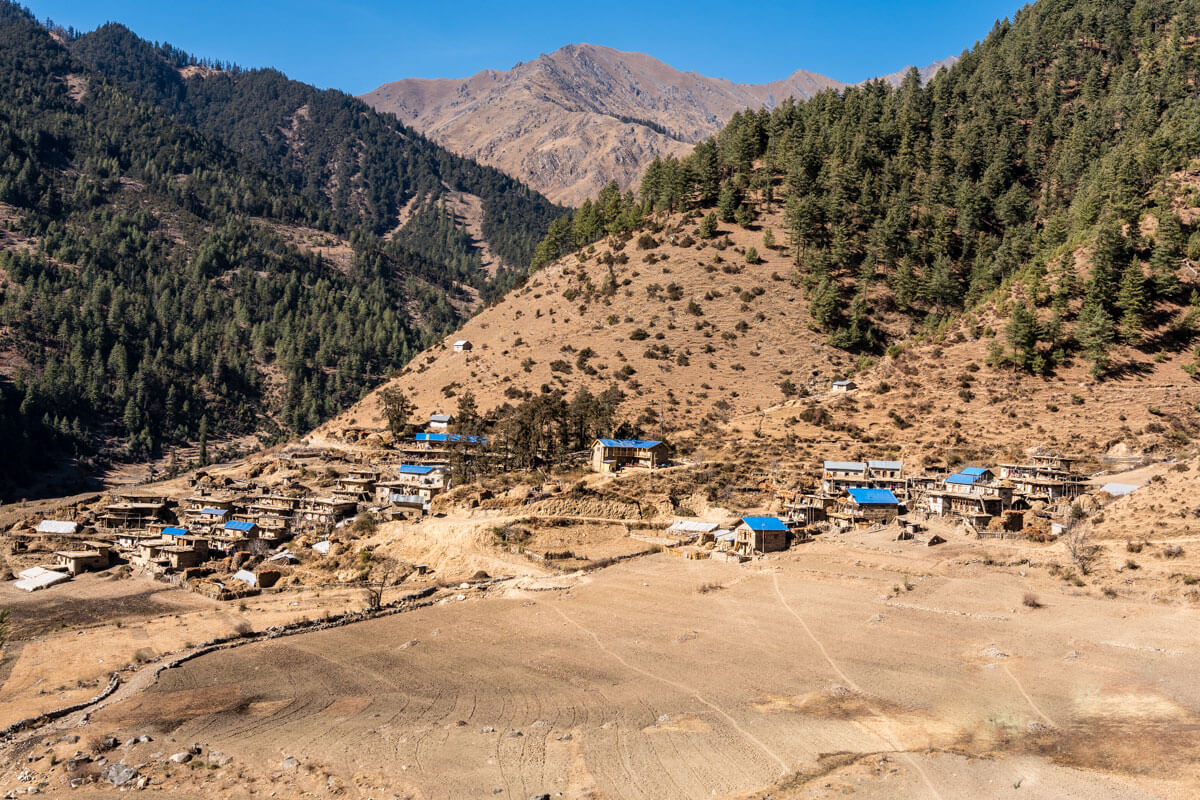
In Humla, religious practices primarily include Shamanism (a mix of Hinduism, Animism, and witchcraft) and Tibetan Buddhism (practiced by immigrants from Mugu and Tibet). Local healers, known as Dhamis and Jhankris, serve as spiritual and medical guides. Nepal is also the birthplace of Buddha (Lumbini), reflecting the intertwined history of Hinduism and Buddhism throughout the country.