Explore Nepal

Discover the rich culture, geography and vibrant communities of Nepal.

Geography, Resources, and Time in Nepal

Official Name: State of Nepal

Area: 147,181 sq. km (56,827 sq. mi)

Altitude: Ranges from 70 meters in the lowlands of the Terai, along the border with India, to 8,848 meters at the summit of Mount Everest.

Natural Resources: Quartz, timber, water, hydropower, scenic landscapes, and small deposits of lignite, copper, cobalt, and iron ore.

Land Use: Arable land: 17% | Permanent crops: 0% | Permanent pastures: 15% | Forests and woodland: 42% | Other: 26%

Irrigated Land: Approximately 11,700 sq. km (2003 estimate)

Natural Hazards: Severe thunderstorms, flooding, landslides, drought, and potential famine, often influenced by the timing, intensity, and duration of the summer monsoon season.

Environmental Issues: Heavy reliance on wood for fuel and the widespread clearing of forests for agriculture without replanting has led to significant deforestation, soil erosion, and water pollution. Contaminated water sources pose health risks to communities.

Estimated Population: 28,901,790 (July 2007 estimate)

Time Zone: Nepal Standard Time (NST) is 5 hours and 45 minutes ahead of GMT and 15 minutes ahead of Indian Standard Time (IST).

Calendar: Nepal follows its own solar calendar, the Bikram Sambat, which in 2000 (western calendar) counted the year 2057. The Nepali new year begins in mid-April. Dates for religious holidays and festivals are based on lunar phases.

Ethnic and Cultural Diversity in Nepal

Nepal’s population is broadly categorized into two major ethnic groups. The first group, the Indo-Nepalese, includes communities such as the Pahari, Newar, Tharu, and the Indians of the Tarai region, collectively representing nearly 80% of the population. The second group, the Tibeto-Nepalese, comprises the remaining population and consists of ethnicities like the Tamang, Rai, Limbu, Bhote, Sunwar, Magar, and Gurung. The Tibeto-Nepalese share cultural and racial ties with the Tibetan people.

The country is home to a wide range of ethnic cultures, each with distinct languages, traditions, and customs. These groups can often be identified geographically based on where they traditionally reside. For instance, the Sherpas, who belong to the Tibeto-Burman lineage, predominantly live in the high hills of eastern and central Nepal. The Solu Khumbu region, home to Mount Everest, is primarily inhabited by Sherpas. Most Sherpas practice Buddhism, while some follow the Bon religion—the pre-Buddhist spiritual tradition of Tibet—or other faiths. Known for their courage and expertise in mountaineering, Sherpas are often engaged in professional expeditions, though many today also pursue careers in business, government, and politics.

The mid-hills of Nepal are inhabited by a variety of ethnic groups. Among them are the Kirats, including the Limbus and Rais, who historically were warriors and skilled hunters. Traditionally practicing ancestor worship, many Kirats now follow Hinduism. Speaking Tibeto-Burman languages, numerous members of these communities also serve in the British army, earning recognition as the brave Gurkhas.

In the Kathmandu Valley, the majority population is made up of Newars, who speak Nepali and practice a blend of Hinduism and Buddhism. Many Newar families observe both Hindu and Buddhist festivals, and their culture incorporates elements of tantrism and animism. Known for their entrepreneurial spirit, Newars manage a significant portion of the Valley’s businesses and historically contributed to the establishment of the artistically renowned cities of Patan, Bhaktapur, and Kathmandu.

Surrounding the Kathmandu Valley, the Tamang people form one of the largest Tibeto-Burman groups in Nepal. The word “Tamang” translates to “horse soldier” in Tibetan, reflecting their historic role as cavalry. Today, Tamangs primarily engage in farming and work as semi-skilled or unskilled laborers. They practice Tibetan Lamaism or follow the Bon religion and maintain their own language and cultural identity.

Ethnic Groups, Demographics, and Cultural Heritage of Nepal

The Magars inhabit the western and central hills of Nepal. Before the 18th century, they maintained their own kingdoms and were closely linked with the Hindu Indo-Aryans in the western regions. Many of their cultural practices have been influenced by the Chhetris, making it challenging today to distinguish between the two groups in terms of housing, clothing, and farming. The Magars have long been recruited by the British and Indian armies, with many serving in Gurkha regiments. A similar ethnic group, the Gurungs, lives slightly further east in the western and central hills. Of Tibeto-Burman origin, the Gurungs have their own language and practice shamanism. Many also serve in British and Indian military forces.

The Khas group, which includes the Bahuns and Chhetris, historically established kingdoms in the far western regions. Bahuns traditionally serve as priests and are among the most educated ethnic groups, often holding key government and educational positions today. Chhetris are known as warriors, and those residing in the higher hills face challenging lives due to limited rainfall, cultivating land mainly in river valleys and hill slopes.

The Tharus are among the original inhabitants of the Terai plains, while other ethnic groups such as the Majhi, Danuwar, Rajbansi, Darai, Satar, and Dhimal also occupy the flatlands. Tharus follow their own indigenous religion and practice animism. Their culture is well-suited to the hot plains, and they have natural resistance to malaria. They have Mongoloid features and speak their own language.

Cultural boundaries are increasingly fluid due to migration, and the urban population grows by about 7% each year, resulting in significant intermingling among communities.


Demographic and Vital Statistics

  • Population Density: 131.7 persons per sq km (341 per sq mi) (1991)
  • Urban vs Rural: 9.6% urban, 90.4% rural (1990)
  • Sex Distribution: 51.7% male, 48.3% female (1990)
  • Life Expectancy at Birth: Male 55.4 years, Female 52.6 years (1990); Male 46 years, Female 42 years
  • Age Distribution: 0–14 years: 41% | 15–64 years: 55% | 65+ years: 4% (1999 est.)
  • Birth Rate: 38 per 1,000 (1993)
  • Death Rate: 13 per 1,000 (1993)
  • Population Growth Rate: 2.51% (1999 est.)
  • Infant Mortality Rate: 90 per 1,000 live births (1999 est.)
  • Total Fertility Rate: 4.78 children per woman (1999 est.)

Location and Geography

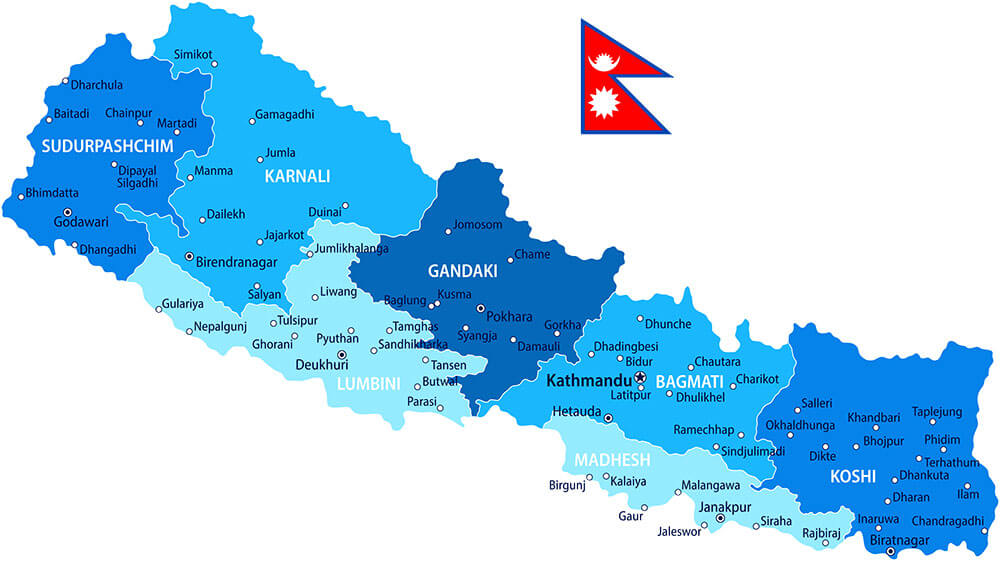
Nepal is situated along the southern slopes of the Himalayan Mountains in South Central Asia, bordered by China to the north and India to the east, west, and south. The country is divided into three main topographical regions:

  1. High Mountains: Including the Himalayan peaks such as Mt. Everest, Mt. Lhotse, and Mt. Makalu.
  2. Kathmandu Valley: A circular basin enclosed by tertiary ranges known as the Siwalik Hills.
  3. Terai: A narrow, fertile flat belt along the southern border with India.

Major rivers include the Kosi, Narayani (Gandak), and Karnali Gogra. Principal cities (1991 estimates) are Kathmandu (419,100), Biratnagar (130,100), Lalitpur (117,200), Pokhara (95,300), and Bhaktapur (68,800). Land use (1992) includes forests 39%, pastures 15%, cultivated land 17%, and other 29%.


Languages

The official language of Nepal is Nepali, spoken as a first language by approximately 55% of the population and widely understood by others. In total, there are 71 languages spoken throughout the country.


Religion

Nepal is predominantly Hindu (89%), followed by Buddhists (7%), Muslims (3%), Christians (0.6%), and other faiths (0.4%). Nepal was the world’s only Hindu kingdom until May 18, 2006, when it became a secular state. Hindu temples and Buddhist shrines are widespread across the mountains and valleys.

Nepalese society is deeply religious, family-oriented, and modest. Many attribute misfortune or fortune to fate or karma. Traditional beliefs include spirits such as bhoot (ghosts), pret (evil spirits), boksi (witches), and graha dasha (inauspicious planetary positions) which are thought to affect health, crops, and daily life. Offerings of incense, flowers, and food are common to appease spirits, and sometimes animals such as roosters or male goats are sacrificed.

Caste consciousness, historically organized into four main groups—Brahman (priests), Kshatriya (nobles and warriors), Vaisya (traders and farmers), and Sudra (servants)—continues to influence social behavior, with thousands of subdivisions.

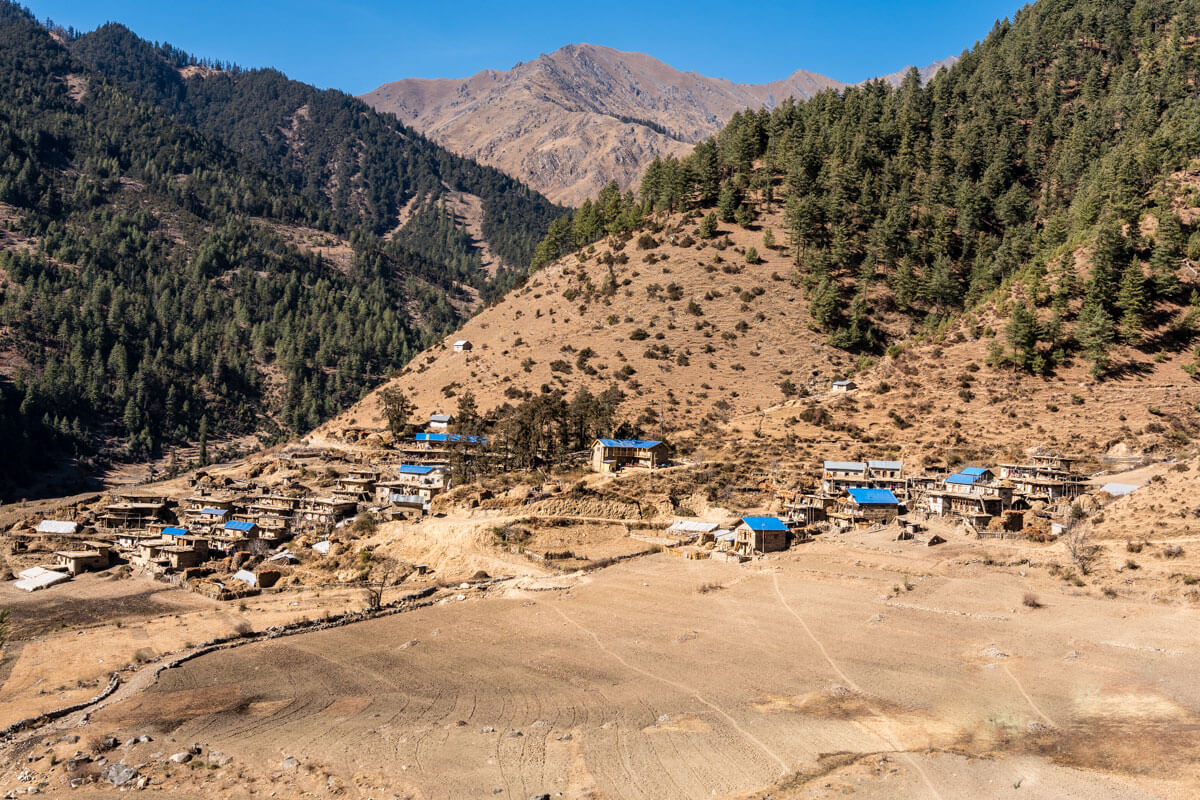
In Humla, religious practices primarily include Shamanism (a mix of Hinduism, Animism, and witchcraft) and Tibetan Buddhism (practiced by immigrants from Mugu and Tibet). Local healers, known as Dhamis and Jhankris, serve as spiritual and medical guides. Nepal is also the birthplace of Buddha (Lumbini), reflecting the intertwined history of Hinduism and Buddhism throughout the country.

Government & Economy of Nepal

Government Structure

Nepal operates as a federal parliamentary republic, with a multi-party system and a bicameral legislature. The country is divided into 7 provinces, each with its own provincial government. The President serves as the ceremonial head of state, while the Prime Minister is the head of government and exercises executive powers.

  • Capital: Kathmandu

  • Constitution: Adopted in 2015, establishing a secular, inclusive, and democratic republic.

  • Legal System: Based on the Constitution of Nepal, incorporating elements of common law and customary law.

  • Suffrage: Universal adult suffrage at 18 years of age.

National Symbols

  • Flag: Nepal’s flag is unique, consisting of two stacked triangles with crimson and deep blue borders. The upper triangle features a white moon, and the lower triangle displays a white sun.

  • National Flower: Rhododendron (Lali Gurans)

  • National Bird: Himalayan Monal (Danphe)

  • National Animal: Cow

  • National Color: Crimson

Economy Overview

Nepal’s economy is classified as a lower-middle-income economy, with agriculture, services, and industry contributing to its GDP. The country is heavily reliant on remittances, tourism, and agriculture.

  • GDP (Nominal): Approximately $46.08 billion (2024 estimate)

  • GDP per Capita (Nominal): Around $1,460 (2024 estimate)

  • GDP Growth Rate: Projected at 4.0% for FY2025-26

  • Inflation Rate: Approximately 4.1% as of September 2024

  • Unemployment Rate: Estimated at 12.6% in 2022

  • Poverty Rate: About 10.8% in 2022

Economic Sectors

  • Agriculture: 24.5% of GDP

  • Industry: 13.7% of GDP

  • Services: 61.8% of GDP

Key Industries

  • Tourism: A significant contributor to GDP, attracting visitors to the Himalayas and cultural sites.

  • Manufacturing: Includes textiles, carpets, garments, and small-scale industries.

  • Agriculture: Major products include rice, maize, wheat, sugarcane, and dairy.

Trade and Exports

  • Exports: Approximately $2.13 billion in 2023-24

    • Major Exports: Garments, carpets, textiles, jute products, and agricultural goods

    • Primary Export Partners: India, United States, Germany, and the United Kingdom

  • Imports: Around $11.8 billion in 2023-24

    • Major Imports: Petroleum products, machinery, gold, electrical goods, and pharmaceuticals

    • Primary Import Partners: India, Singapore, Japan, and Germany

Currency and Fiscal Information

  • Currency: Nepalese Rupee (NPR)

  • Fiscal Year: July 16 to July 15

  • Exchange Rate: Approximately 1 USD = 133 NPR (as of 2025)

Health and Education

  • Life Expectancy: Approximately 71 years

  • Literacy Rate: Estimated at 67.9% for the total population, with urban areas having higher rates

  • Major Health Risks: Include altitude sickness, hepatitis A, malaria (in low-lying areas), and typhoid

Traveling to Nepal

By Air

Nepal’s primary international gateway is Tribhuvan International Airport (KTM) in Kathmandu. The airport serves as the hub for Nepal Airlines, the national flag carrier, which operates scheduled flights to various international destinations. As of the latest information, Nepal Airlines offers flights to the following cities:

  • Delhi, Mumbai, Bengaluru (India)
  • Bangkok (Thailand)
  • Hong Kong
  • Kuala Lumpur (Malaysia)
  • Doha (Qatar)
  • Dubai (UAE)
  • Tokyo (Narita) (Japan)

Additionally, several international airlines operate flights to Kathmandu, including Qatar Airways, Singapore Airlines, Thai Airways, and Emirates, connecting Nepal to major cities worldwide.

By Land

Nepal shares open land borders with India and China, with multiple entry and exit points:

India-Nepal Border Crossings:

  • Kakarbhitta (Eastern Nepal)
  • Birgunj (Central Nepal)
  • Belhiya (Bhairahawa) (Western Nepal)
  • Nepalgunj (Mid-Western Nepal)
  • Dhangadi (Far Western Nepal)
  • Mahendranagar (Far Western Nepal)

China-Nepal Border Crossing:

  • Kodari (Sindhupalchowk District)

These land crossings facilitate both trade and tourism, with various entry points monitored by the Department of Immigration, Government of Nepal.


Travel Routes and Domestic Connectivity

Nepal Airlines operates an extensive domestic network, connecting Kathmandu to various regional airports. As of the latest schedule, flights are available to destinations such as Rukum, Rumjatar, Lamidanda, and Pokhara, among others. The airline utilizes aircraft like the DHC-6 Twin Otter for these routes, offering scenic views of the Himalayas.

Other domestic carriers, including Yeti Airlines, Saurya Airlines, and Buddha Air, also provide regular and charter services to various destinations across Nepal.


Major Tourist Attractions

Nepal is renowned for its diverse landscapes, rich culture, and historical sites. Key attractions include:

  • Mount Everest: The world’s highest peak, offering trekking opportunities and mountain flights.
  • Annapurna Circuit: A popular trekking route known for its diverse ecosystems and stunning mountain views.
  • Pokhara: A lakeside city offering adventure sports, boating, and panoramic views of the Himalayas.
  • Chitwan National Park: A UNESCO World Heritage Site known for wildlife safaris and conservation efforts.
  • Lumbini: The birthplace of Lord Buddha, attracting pilgrims and tourists alike.
  • Kathmandu Valley: Home to historic sites like Pashupatinath Temple, Boudhanath Stupa, and the Durbar Squares of Kathmandu, Bhaktapur, and Patan.

These attractions offer a blend of natural beauty, cultural heritage, and spiritual significance, making Nepal a unique destination for travelers.

Social Customs and Daily Life in Nepal

Greetings

The traditional greeting in Nepal is Namaste, performed by pressing the palms together in front of the chest or chin and saying “Namaste” (or “Namaskar” for elders and superiors). In informal settings, a raised right hand in a salaam gesture may also be used for greetings and farewells. During formal gatherings, guests may receive a mala (flower garland) or, in some Buddhist communities, a khada (white scarf) as a sign of respect. Handshakes are uncommon, though some men may shake hands with Western visitors or with each other. Using proper titles or the suffix -jee or -jye shows respect in formal interactions.


Gestures and Etiquette

Respecting personal space and cultural norms is important in Nepal. Key practices include:

  • Avoid touching someone’s head or shoulders.
  • Physical contact between men and women in public is discouraged; affectionate gestures are reserved for private settings.
  • Feet should never point at people, sacred animals (like cows), temples, stupas, or banyan trees, and touching objects with the feet is considered disrespectful.
  • Beckoning is done by waving all fingers downward, and pointing with fingers is impolite.
  • Whistling indoors or at night, winking at the opposite sex, or mishandling food and flowers is culturally inappropriate.

Visiting Customs

Nepalese hospitality is warm and welcoming. Visiting friends and relatives is an integral part of daily life, and hosts are patient with late arrivals. Guests are typically offered tea with sugar and milk, and shoes are removed when entering homes, temples, or mosques. Small gifts, often for children, are appreciated when visiting, and objects are generally handled with the right hand. Social interactions between genders vary by region, with more segregation observed in southern Nepal.


Eating Habits

Meals in Nepalese households are traditionally served in order of men, guests, children, and then women. Food etiquette emphasizes hygiene and caste-based purity (jutho):

  • Sharing utensils or plates across castes is avoided.
  • Lips should not touch communal containers.
  • Brahmans, the highest caste, prepare meals at gatherings involving multiple castes.
  • Payment for meals when dining out is typically the responsibility of the higher-income person.
  • Regional differences exist: chopsticks are used in some northern districts, while most eat with their hands.

Family Life

Family interests take precedence over individual desires. Extended families often live together, sharing kitchens and responsibilities. Elderly members are respected and cared for by younger relatives. In urban areas, nuclear families are increasingly common. Land inheritance is traditionally through sons, though legal reforms have gradually increased women’s property rights. Rural women marry young and typically join their husband’s household, taking on household and farming duties. Homes range from modest two-level stone and mud houses in rural areas to brick or concrete buildings in urban areas. Higher-caste families in the south may live in larger, well-built homes, while lower-caste families often face poverty.


Dating and Marriage

Marriage in Nepal is mostly arranged by parents, though some couples may consent to the union. It is regarded as sacred and lifelong. Western-style dating and divorce are uncommon. Sherpas may cohabit before marriage, and weddings are elaborate celebrations lasting up to three days. In the southern Terai, dowries are customary. Chastity is highly valued for women entering marriage.


Diet and Cuisine

Nepalese diets vary by region and caste:

  • Higher-caste Hindus often follow vegetarian diets or eat limited meat, typically goat.
  • Middle-caste families consume chicken, goat, or water buffalo when available.
  • Hindus avoid beef, and Muslims avoid pork.
  • Meals are predominantly rice with lentil soup and vegetable curry in urban areas and the Terai, while millet and corn are staples in hill regions.
  • Hill communities consume porridge (dhedo) made from corn, millet, or buckwheat.
  • Sherpas and Tibetans consume more meat, and seasonal fruits and vegetables are widely used.

Nepal’s Transition from Monarchy to Federal Democratic Republic

The End of the Shah Dynasty

Nepal’s monarchy, established in 1768 by King Prithvi Narayan Shah, endured for over two centuries under the Shah dynasty. The monarchy’s downfall culminated on May 28, 2008, when Nepal’s Constituent Assembly voted to abolish the 239-year-old Hindu monarchy, transitioning the nation into a federal democratic republic.

Prelude to Abolition: The Maoist Insurgency and the People’s Movement

The seeds of the monarchy’s decline were sown during the decade-long Maoist insurgency, which began in 1996. The conflict, aimed at establishing a people’s republic, resulted in over 17,000 deaths and widespread upheaval. In 2005, King Gyanendra’s assumption of absolute power to combat the Maoists led to widespread protests. The 2006 People’s Movement (Loktantra Andolan) forced the king to relinquish his absolute authority, leading to the restoration of the parliament.

The Abolition of the Monarchy

Following the 2006 peace agreement with the Maoists, the monarchy’s future became a central issue. In December 2007, it was agreed that the monarchy would be abolished. Elections for the Constituent Assembly were held in April 2008, with the Maoists securing the most seats. On May 28, 2008, the assembly voted to end the monarchy, and King Gyanendra was given 15 days to vacate the Narayanhiti Palace.

Post-Monarchy Nepal: Political Instability and the Push for Restoration

Since the abolition of the monarchy, Nepal has experienced significant political instability, with 14 different governments formed between 2008 and 2025. This instability has led to public disillusionment with the political system. In recent years, there has been a resurgence of royalist sentiments, with pro-monarchy protests occurring in Kathmandu. In March 2025, clashes between protesters and police resulted in two deaths and over 100 injuries. Despite these movements, King Gyanendra has remained a private citizen, and the monarchy has not been restored.

The Current Political Landscape

As of 2025, Nepal operates as a federal democratic republic. The presidency is largely ceremonial, with Ram Chandra Poudel serving as the current president. Prime Minister K.P. Sharma Oli, from the Communist Party of Nepal (Unified Marxist Leninist), has been appointed as the fifth prime minister in five years, reflecting ongoing efforts to stabilize the political environment.